
Department of Food & Animal Sciences
Ensuring a Safe and Productive Food Supply
Welcome to the Department of Food & Animal Sciences (DFAS)
At the Department of Food & Animal Sciences, we’re dedicated to shaping the future of food systems, animal health, and agricultural innovation. We combine rigorous scientific training, real-world application, and forward-thinking research to prepare students for a wide range of career paths—from food safety and regulatory affairs, to animal welfare, biotechnology, production systems, and beyond.
What Makes Us Different
- Hands-on, immersive learning. Just like top programs around the country, students in our core courses experience lab, farm, and processing facility work early in their studies. We believe learning is maximized by doing—not just seeing.
- Faculty‑mentored inquiry. Our faculty are not just teachers—they’re active researchers, committed to mentoring both undergraduates and graduate students in cutting‑edge projects.
- Interdisciplinary & societal relevance. We tackle issues with global, local, and environmental importance—food safety, sustainable animal production, animal health & welfare, nutrition, regulatory science, and trade.
- Partnerships & outreach. We work with industry, governmental agencies, extension services, and community programs to ensure our research translates into practice (e.g. applied projects, internships, extension programs).
- Innovation & technology. We continuously upgrade facilities and integrate new technologies—whether in food processing, molecular biology, genomics, or data analytics—to stay ahead in a rapidly changing field.
Programs & Pathways
We offer both undergraduate and graduate degree programs, each structured to support specialization, professional development, and research.
-
Undergraduate Programs:
Students may choose from emphases including Animal Science, Food Science, and Pre‑Veterinary Medicine. The curriculum balances foundational sciences (biology, chemistry, physiology), specialized courses (nutrition, food safety, processing, animal health), and hands‑on experiential learning. -
Graduate Programs:
Our Master of Science in Food & Animal Sciences engages students in advanced coursework and research. Graduate students have opportunities to collaborate on faculty‑led research, contribute to strategic outreach and extension efforts, and develop leadership skills for careers in industry, academia, or public service.
Our Community: Faculty & Support
Our strength lies in our people. We have a diverse, dedicated faculty who are leaders in their disciplines—ranging from animal nutrition, physiology, and genetics, to food chemistry, microbiology, processing, and regulatory policy. Faculty actively publish, secure external funding, and partner with industry and public entities. What’s more, they are deeply invested in student success: mentoring, advising, guiding research, and helping students build professional networks.
Want to meet them? See our full [Faculty Directory] (insert hyperlink to your directory page here).
Your Future Starts Here
Joining the Department of Food & Animal Sciences means being part of a community striving for excellence and impact. Whether your goal is to lead innovation in food systems, safeguard animal health, enter veterinary school, or drive sustainable agricultural practices, we support your journey. With experiential learning, strong mentorship, and a curriculum relevant to today’s challenges, we prepare our students to make real contributions from day one.
|
Have you always enjoyed working with animals and looking for a way to turn that interest into a career? Look no further! |

TSU's Food & Animal Sciences program provides a rigorous scientific curriculum that is necessary to comprehend the real-world challenges associated with many facets of the food system. The nation is experiencing an increasing need for professionals trained in Food and Animal Science. Interested students have the opportunities to participate in state-of-the-art research with a faculty mentor. Students are trained with the knowledge and skills needed for the numerous job opportunities available in the food and animal industry as well as the public sector.
The College hosts an impressive faculty in the Food and Animal Sciences with a wide range of expertise across the research, extension, and teaching mission areas who work to solve the problems facing Tennessee, the United States, and the world.
Explore the Graduate Program >>
Explore the Under Graduate Program >>
Explore Food & Animal Sciences Faculty >>

All faculty members are experts in their specialized fields and are actively involved in various aspects of food and animal research to solve problems related to food safety, food quality, nutrition, animal production, and animal health. Students are prepared to work for the USDA, the EPA and other regulatory agencies or in the private sector.

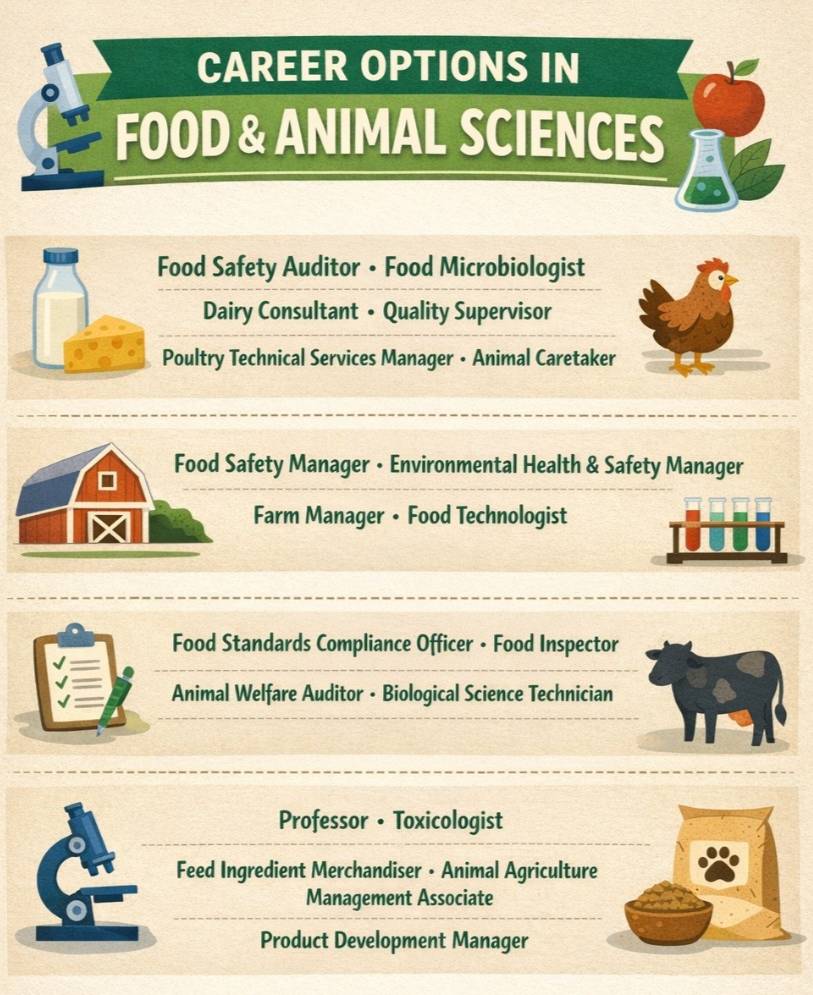
Food Safety Auditor • Food Microbiologist Dairy Consultant • Quality Supervisor Poultry Technical Services Manager Animal Caretaker • Food Safety Manager Environmental Health & Safety Manager Farm Manager • Food Technologist
Food Standards Compliance Officer • Food Inspector • Animal Welfare Auditor Biological Science Technician • Professor • Toxicologist • Feed Ingredient Merchandiser • Animal Agriculture Management Associate Product Development Manager
What Classes are needed for a Food and Animal Sciences Concentration?
View complete degree maps >>
Food and Animal Science - Pre Veterinary Emphasis
Food and Animal Science - Animal Science Empahsis
Food and Animal Science - Food Science Emphasis

The College of Agriculture offers several financial awards designed to assist students with funding their education. Students can apply for the Dean’s Scholars or Leadership Development programs.

Food Science
Dr. Gajender Aleti
Dr. Fur-Chi Chen
Dr. Rita Fleming
Dr. Aliyar Fouladkhah
Dr. Agnes Kilonzo-Nthenge
Dr. Brione Lockett
Dr. Ankit Patras
Dr. Brahmaiah Pendyala
Dr. Hongwei Si
Dr. Ying Wu
Animal Science
Dr. Richard Browning
Dr. Samuel Nahashon
Dr. Yongming Sang
About the Program
Mission:
Our mission is to foster excellence in food and animal sciences through innovative teaching, transformative research, and experiential learning. We empower students and faculty to become problem solvers and industry leaders. Through meaningful community engagement, outreach, and strong partnerships with stakeholders, we work to advance a safe and sustainable food and animal system that meets the needs of a changing world.
Vision:
The Department of Food and Animal Sciences will be a great choice for student-centered learning and a reliable source of evidence-based information in support of training students and other stakeholders to become national and global leaders in the food sciences, animal sciences and related fields.
Goals:
(a) Keep the academic programs/curriculum current and relevant to current and future workforce needs.
(b) Recruit outstanding students who can successfully complete a rigorous curriculum in a timely manner.
(c) Prepare students for high skill, wage, and demand career opportunities through teaching, mentoring, providing hands-on research and service experiential learning and internships.
(d) Develop avenues of generating resources to augment the annual budget in support of the academic programs and to provide financial support to students; and
(e) Increase collaborations and seek input from industry and potential employers when establishing new programs and revising curriculum; these groups will be involved through organized advisory committees.

Samuel N. Nahashon
Professor and Department Head
Department of Food and Animal Sciences
College of Agriculture
Contact Information:
Office Location: 204G Farrell-Westbrook Complex
Telephone: 615-963-5829
FAX: 615-963-5436
Email:
snahashon@tnstate.edu
Jason Foster, Administrative Assistant
204 Farrell-Westbrook Complex
Email: jfoste44@tnstate.edu
Graduate Coordinator:
Dr. Ying Wu, Professor
(615) 963-5824 | ywu@tnstate.edu
AG PROFESSOR RECEIVES HONOR
Coming soon....
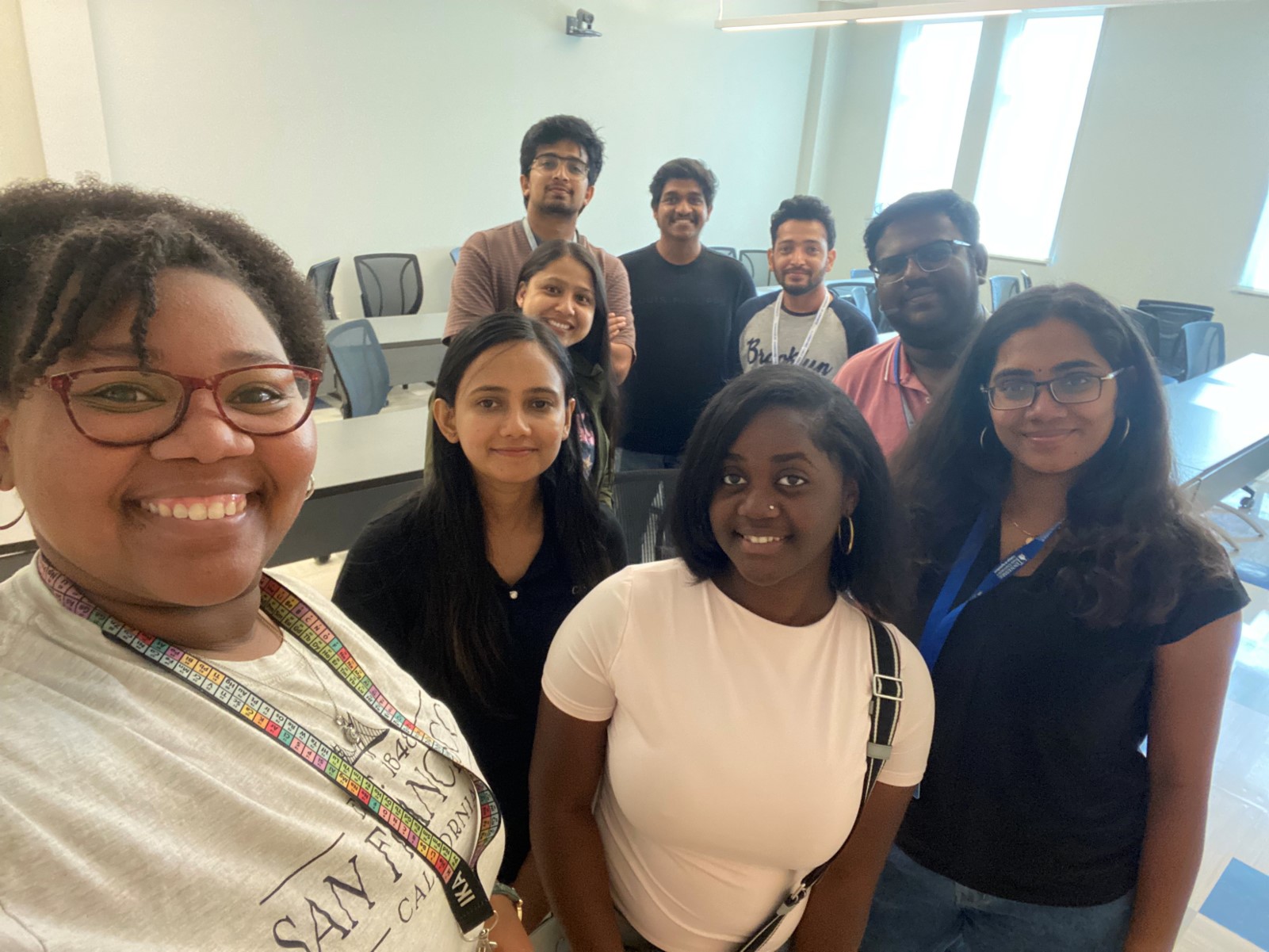
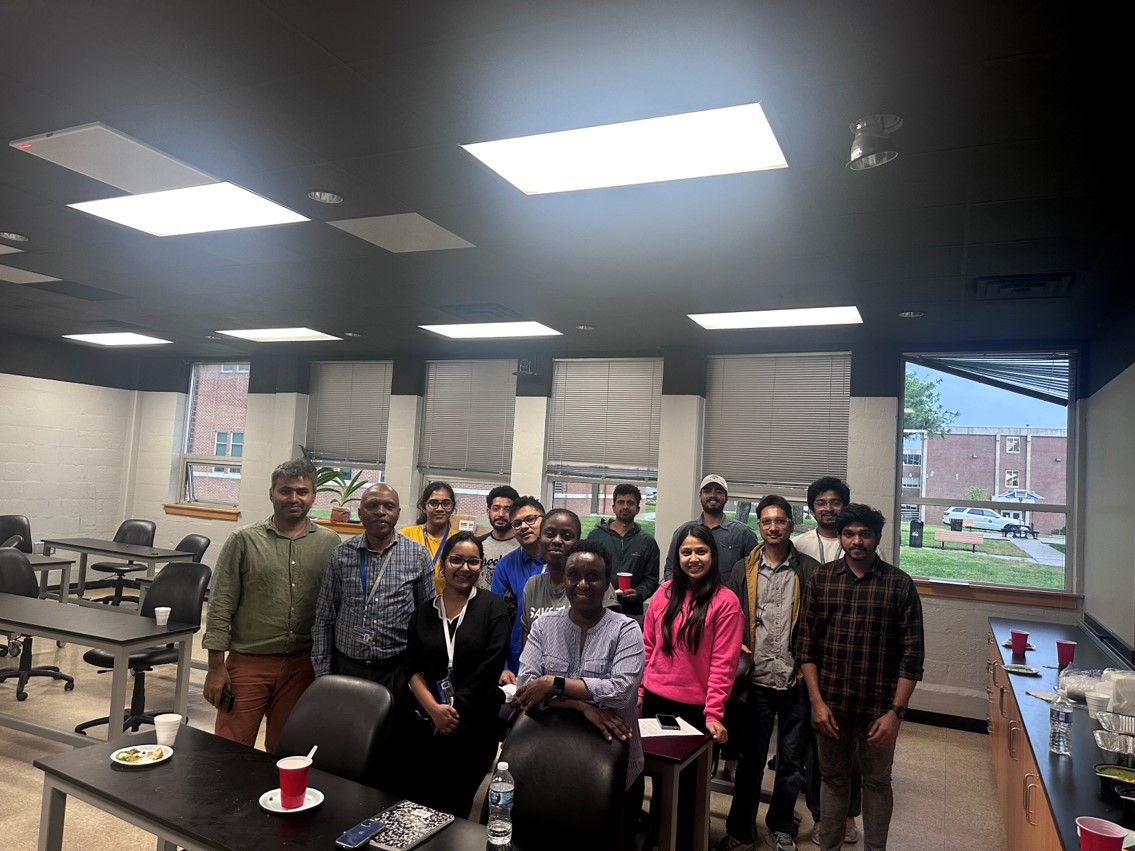
STUDENTS ATTEND ORIENTATION SESSION
On 02-05-2026, undergraduate students participated in a Q&A session with Dr. Nahashon. Graduate students attended the orientation, which featured a fun and engaging interaction with faculty and fellow students.