

- Home >
- Electrical & Computer Engineering >
- Faculty
- > Kamrul Hasan
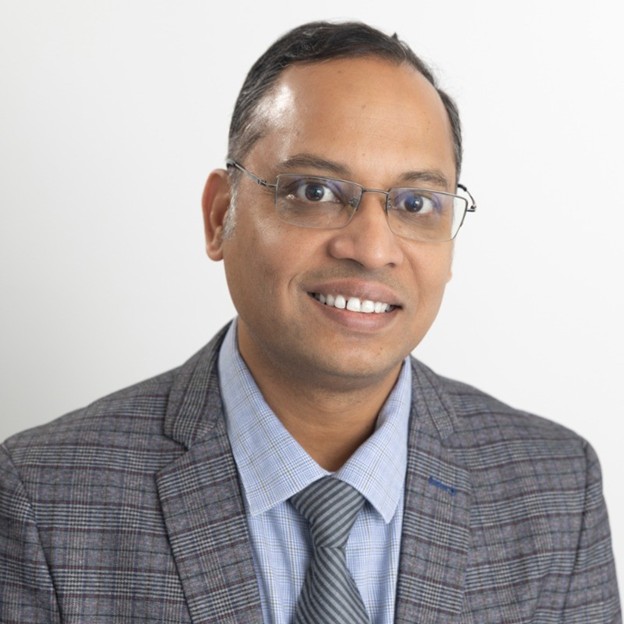
Shazzad Rassel
Assistant Professor
|
Dr. Shazzad Rassel is a Tenure-Track Assistant Professor in the Department of Electrical and Computer Engineering at Tennessee State University. He has over 13 years of research and teaching experience across the U.S. and Canada, with expertise in semiconductor device fabrication, processing, and characterization (III–V materials), and biomedical sensing technologies including noninvasive blood glucose detection using photoacoustic and capacitance spectroscopy.
|
Phone: 615-963-1848 |
EDUCATION
Ph.D., Electrical and Computer Engineering, University of Oklahoma (2018).
M.Sc., Electrical and Computer Engineering, University of Oklahoma (2014).
MBA, Management Information System, University of Dhaka, Bangladesh (2008).
B.Sc., Electrical and Electronics Engineering, Islamic University of Technology, Bangladesh (2003).
EXPERIENCE
Tenure-Track Assistant Professor, Tennessee State University, Nashville, TN (2024–Present).
Tenure-Track Assistant Professor, Fairmont State University, Fairmont, WV (2023–2024).
Sessional Instructor, Conestoga College, Canada (2022–2023).
Sessional Instructor, Wilfrid Laurier University, Canada (2023).
Graduate Teaching Assistant, University of Oklahoma, USA (2011–2018).
Lecturer, Islamic University of Technology, Bangladesh (2002–2005).
RESEARCH
Research Portfolio:
Mid-IR and THz semiconductor lasers and detectors; high-speed optoelectronics and free-space optical links.
Noninvasive glucose sensing using photoacoustic spectroscopy and capacitance spectroscopy; AI/ML for biosensing data.
Micro- and nanofabrication: lithography, wet/dry etching (RIE/ICP), deposition (PECVD/sputter/e-beam/thermal), packaging and wire bonding.
Failure analysis using SEM/EDS and process troubleshooting for III–V device fabrication.
Microelectronics workforce and lab capacity development; hands-on training modules and student mentorship.
Current Research Projects:
Non-invasive glucose detection by integrating capacitance and photoacoustic spectroscopy using glucose-sensitive IR laser excitation; applying AI/ML models to predict glucose levels.
Infrared-thermal imagery processing (e.g., human forearm) to correlate thermal features with blood glucose levels.
Selected Grant/Funding History (PI/Co-PI):
2025 – $76,000, Co-PI, SCALE microelectronics (Tennessee State University).
2024 – $100,000, PI, NREL MSI Prize (DOE Deploy 24).
2024 – $10,000, PI, TSU in-house seed grant.
2023 – $5,000, PI, NASA student research (Fairmont State University).
2022 – $110,000, Co-PI, Mitacs extension (University of Waterloo).
2020 – $110,000, Co-PI, Mitacs extension (University of Waterloo).
PUBLICATIONS (Selected)
- Optimization of a T-Cell Resonator: Towards Highly Sensitive Photoacoustic Spectroscopy for NonInvasive Blood Glucose Detection, Biosensors (2025).
- Photoacoustic Resonator for Noninvasive Blood Glucose Detection through Photoacoustic Spectroscopy: A Systematic Review, Sensors (2024).
- Progress and perspectives of mid-infrared photoacoustic spectroscopy for noninvasive glucose detection, Biosensors (2024).
- Roles of Surfactants in Perovskite Solar Cells, Heliyon (2024).
- Dual quantum cascade lasers for noninvasive glucose detection using photoacoustic spectroscopy, Scientific Reports (2023).
- Noninvasive blood sugar detection by cost-effective capacitance spectroscopy, Journal of Sensors and Sensor Systems (2023).