


- Home >
- Data Science
- > Curriculum
Curriculum - AI Concentration
Overview
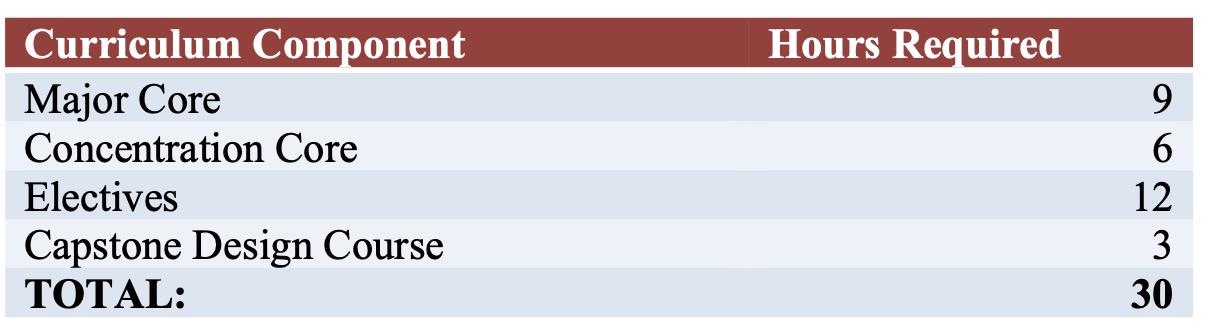
All students in the AI Concentration are required to complete a total of 30 credit hours.
Program Core Courses
All students in the MS in DS Program are required to complete a total of 9 credit hours of core courses.

Concentration Core Courses
All students in the AI Concentration are required to complete a total of 6 credit hours of concentration core courses.

Elective Courses
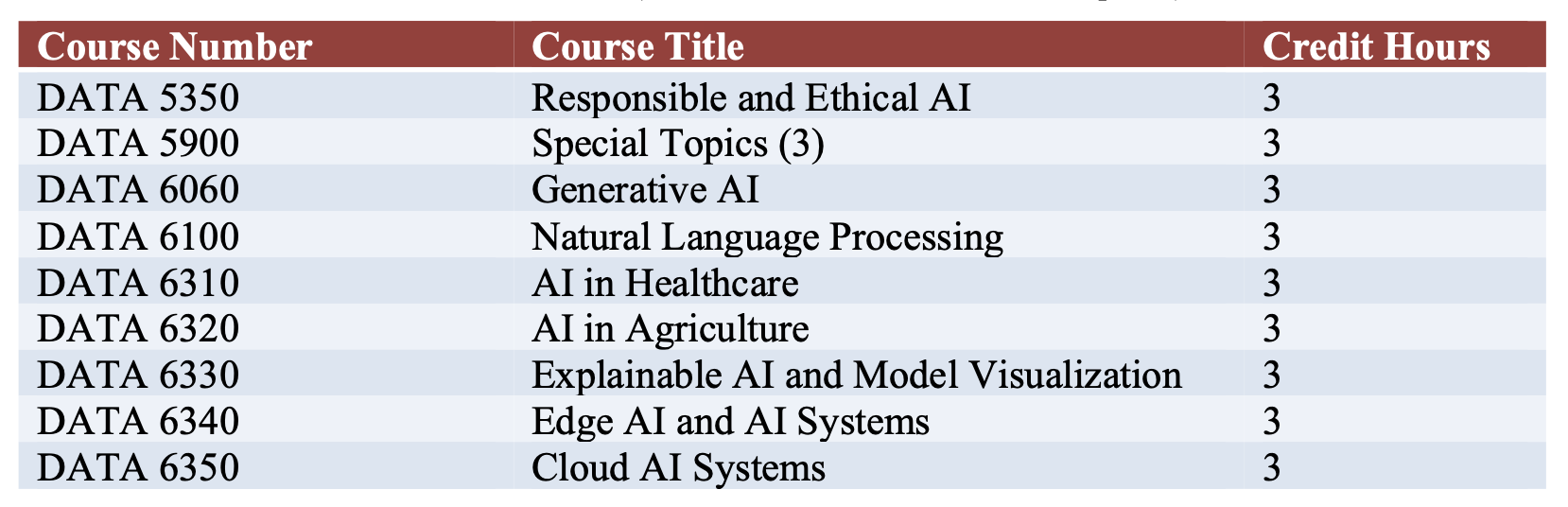
All students in the MS in DS Program are required to complete a total of 12 credit hours of elective courses. The list of courses is given below. Please note that courses outside from the lists can be recommended by an Academic Advisor and approved by the Department.
Capstone Course
All students in the MS in DS Program are required to complete a total of 3 credit hours Capstone Course.

Course Descriptions
DATA 5050 Mathematics for Data Science. (3) This course covers various areas of applied mathematics relevant to data science. Topics from statistics include probability distribution functions, linear regression, and probability calculus, topics from linear algebra include vector spaces, subspaces, matrix factorization concepts, singular value decomposition, and principal component analysis, topics from discrete mathematics include combinatorics, and topics from optimization include convex optimization and constrained programming. Prerequisite: MATH 2010 or MATH 2050 or MATH 3100 or MATH 3610 or equivalent.
DATA 5100 Programming for Data Science. (3) This is a project-based programming course for data scientists. The course covers the fundamentals of Python programming, the use of Python libraries for information processing and data analysis techniques to solve real-world data science problems. This course is intended for students with prior computer programming experience. Prerequisite: None.
DATA 5150 Introduction to Data Science. (3) This course introduces the foundational concepts, methods, and workflows of data science. Students learn how to apply data science to real-world problems by integrating data collection, cleaning, analysis, visualization, and communication of results. Topics include the data science lifecycle, data types and sources, data wrangling, exploratory data analysis, data visualization principles, an introduction to predictive modeling and model evaluation, and ethical issues related to data science practice. The course emphasizes conceptual understanding and applied problem solving to build a strong foundation for advanced data science coursework. Co-requisites: DATA 5050 and DATA 5100.
DATA 5200 Statistical Learning. (3) This course provides the statistical learning theory. It provides the theoretical basis for many of today's machine learning algorithms. It covers the approaches to learning problems, estimation of the probability measure and problem of learning, conditions for consistency of empirical risk minimization principle, bounds on the risk for indicator loss functions, structural risk minimization principle, stochastic ill-posed problems, estimating the values of function at given points, perceptron and their generalization, support vector methods for estimating indicator and real-valued functions, and support vector machines for pattern recognition. Prerequisite: DATA 5050.
DATA 5250 Machine Learning. (3) This course provides a broad, application-focused introduction to machine learning methods and techniques for students from diverse academic backgrounds. Topics include supervised and unsupervised learning, model selection, feature engineering, model evaluation, ensemble methods, and practical implementation with modern ML libraries. Emphasis is placed on understanding core ML concepts, hands-on application, and critical interpretation of results. Prerequisites: DATA 5050 and DATA 5100.
DATA 5300 Data Mining. (3) This course presents exploratory techniques and analytical models for discovering meaningful patterns and insightful future trends in data. It covers descriptive and predictive data mining models for information retrieval and forecasting. Best practices for data mining are discussed in topics including, data preparation and cleaning, data transformation and manifold learning, data fusion, data modeling for knowledge representation (graph and decision trees), data importance ranking and selection, data-driven model evaluation and interpretation for decision making. Examples are drawn from web mining, spatial and time-series data mining, anomaly detection, and learning from big data sets. Pre-requisite: DATA 5050 and DATA 5100.
DATA 5350 Applied Statistics for Data Science. (3) This course explores the main topics of statistical inference, point and confidence interval estimation, hypothesis tests, maximum likelihood and estimators, unbiased estimators, linear regression, logistic regression, model selection, principal component analysis. Emphasis on how to identify the correct technique for a given problem, computer packages for its computation, and how to interpret the results. Prerequisite: DATA 5050 or MATH 3100 or STAT 3110 or equivalent.
DATA 5400 Algorithms for Data Science. (3) The course providing a survey of data structures and computer algorithms, examines fundamental techniques in algorithm design and analysis, and develops problem-solving skills required in all programs of study involving data science. The topics include data structures for data science, linear and logic regression, clustering, dimensionality reduction, artificial neural networks, market basket analysis, classification and network analysis, and recommendation systems. Prerequisite: DATA 5100.
DATA 5450 Responsible and Ethical AI. (3) This course examines the ethical, legal, and social implications of artificial intelligence systems. Students will explore topics including fairness, accountability, transparency, privacy, and bias in AI. Emphasis is placed on practical frameworks and tools for building responsible AI systems, case studies, and regulatory considerations. Prerequisites: DATA 5050 and DATA 5100.
DATA 5500 Business Data Analytics. (3) This course presents key topics related to using business data for analysis, especially at enterprise-scale. Topics will include market analysis, user and customer behavior analysis, sentiment analysis, and data-driven decisions. Students will complete practical project utilizing tools for large-scale data analytics. Prerequisite: DATA 5050 and DATA 5100.
DATA 5900 Special Topics. (3) This course is for teaching important emerging data science topics that are not covered in other data science courses. Prerequisite: Successful completion of at least 6 hours of data science graduate courses.
DATA 6060 Generative AI. (3) This course provides an applied introduction to generative artificial intelligence, focusing on the design, implementation, and responsible use of foundation models. Topics include prompt engineering, fine-tuning, large language models, generative vision models, evaluation, and applications across multiple domains. Emphasis is placed on hands-on experimentation and practical use cases. Prerequisites: DATA 5050 and DATA 5100.
DATA 6100 Natural Language Processing. (3) The course presents algorithms and techniques for processing, numeric encoding, and mining of human language expressions. This course introduces prominent text modeling and numeric encoding techniques, including bag-of-words, frequency-based features, lexicon-based models, and word embedding models. Topics of text analytics include text processing and normalization, text classification and clustering, sentiment analysis on social media, topic modeling and document summarization, graph-based mining of large document, deep learning of text sequence, and machine translation. This course shares concepts from linguistics, statistics, and computer science. Pre-requisite: DATA 5050 and DATA 5100.
DATA 6150 Applied Deep Learning. (3) This course introduces deep convolutional neural networks with applications in computer vision, speech analysis, text understanding, medical imaging, and data mining. It analyzes various convolutional neural network architectures as effective feature extractors that are fed into fully connected neural networks. Prerequisite: DATA 5050 and DATA 5100.
DATA 6200 Data Science Capstone. (3) This is a project-based course that allows students to work with a faculty or industry mentor to address data-driven problems. Students are expected to apply their knowledge and foundation in data science to analyze and solve problems in various areas of data science. Prerequisite: This course should be taken in last semester.
DATA 6310 AI in Healthcare. (3) This course provides a practical introduction to the use of artificial intelligence and machine learning in healthcare. Topics include clinical data analytics, electronic health records (EHR) integration, clinical decision support, predictive modeling, responsible AI practices, and regulatory considerations in healthcare applications. Students will work with de-identified EHR datasets to design and implement AI models for real-world clinical use cases. Prerequisites: DATA 5050 and DATA 5100. Co-requisite: DATA 5250 (Machine Learning).
DATA 6320 AI in Agriculture. (3) This course provides an applied introduction to the use of artificial intelligence and machine learning in agriculture and environmental systems. Topics include precision agriculture, crop health monitoring, yield prediction, weather and soil analytics, remote sensing, and computer vision. Students will work with real or simulated agricultural datasets to build AI models that support sustainable and efficient farming practices. Prerequisites: DATA 5050 and DATA 5100. Co-requisite: DATA 5250 (Machine Learning).
DATA 6330 Explainable AI and Model Visualization. (3) This course provides an in-depth exploration of methods for interpreting, explaining, and visualizing artificial intelligence and machine learning models. Topics include global and local interpretability, feature attribution methods, visualization techniques for deep learning models, fairness and transparency considerations, and communicating model insights to technical and non-technical audiences. Emphasis is placed on hands-on implementation of explainability methods and visualization tools. Prerequisites: DATA 5050 and DATA 5100. Co-requisite: DATA 5250 (Machine Learning).
DATA 6340 Edge AI and AI Systems. (3) This course provides students with the knowledge and skills to design, deploy, and optimize artificial intelligence models on edge devices and within distributed AI systems. Topics include edge computing architectures, model optimization techniques, on-device inference, streaming data, AI pipelines, deployment strategies, and performance monitoring. Emphasis is placed on real-world implementation and system-level thinking. Prerequisites: DATA 5050 and DATA 5100. Co-requisite: DATA 5250 (Machine Learning).
DATA 6350 Cloud AI Systems. (3) This course provides hands-on experience with building, deploying, and managing AI/ML systems in cloud environments. Students will work with leading cloud platforms to deploy models, build AI pipelines, integrate data services, and scale applications. Topics include managed AI services, serverless architecture, security and governance, performance monitoring, and cost optimization. The course emphasizes practical implementation through cloud labs and a final capstone project. Prerequisites: DATA 5050 and DATA 5100. Co-requisite: DATA 5250 (Machine Learning).